

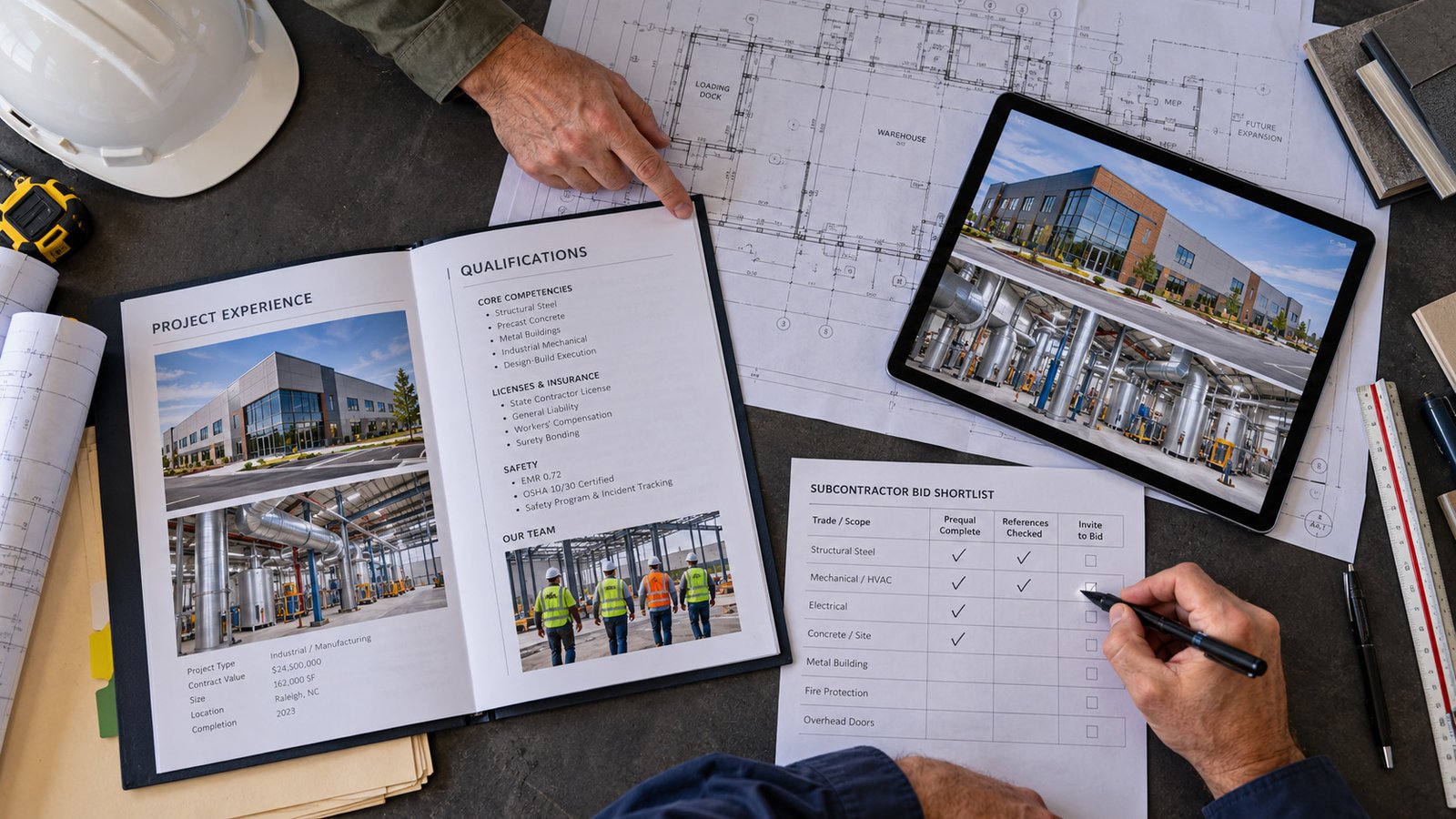
Most commercial work is still won through relationships. A superintendent remembers a sub who showed up and finished clean. An owner’s rep calls the electrical contractor they used on the last building. That won’t change, and it shouldn’t.
But relationships only cover the people who already know you. Every time a GC takes on a new market, loses a sub, or needs a second number on a bid, someone goes looking. So does the owner or developer shortlisting contractors for a new project, and the facility manager replacing a vendor who let them down. Before they call, they check you out. If your website is a slideshow and a phone number, you lose invitations you never knew existed.
I spent 20 years on the sales and supply side of industrial work, where qualifying a new supplier is a formal process. Commercial construction works the same way. Here’s what a GC or owner looks for before adding you to a bid list, and what your site should show.
1. Exactly what you do, and what you don’t
“Full-service commercial contractor” doesn’t help anyone build a bid list. The estimator needs to know your trade, your scope and the kinds of projects you fit.
What to show:
- Your trade and scope, stated plainly: design-assist mechanical, tenant improvements, structural steel erection, and so on
- Project types: office, industrial, healthcare, multifamily, retail, education, whatever you actually build
- The size range you’re best at, such as “$250K to $5M electrical packages”
- New construction, renovation, occupied-building work, or all three
- What you don’t do. It saves everyone time and makes the rest more believable.
2. Where you work
A GC in Marietta doesn’t want to discover on bid day that you won’t go past I-285. Service area is one of the first filters.
What to show: The counties or metro areas you cover, whether you travel for the right project, and where your shop or office is. If you’re licensed in more than one state, say so.
3. The prequalification basics
This is where most contractor websites go quiet, and it’s the information a GC’s prequal form will ask for anyway. Showing it up front tells them you’ll pass.
What to show, as far as you’re comfortable publishing:
- Licenses and the states they cover
- Safety program basics, and your safety record if it’s a strength
- That you carry the insurance and bonding typical for your projects, and who to contact for certificates
- Certifications that matter to your customers, such as minority- or woman-owned business certifications, or manufacturer certifications for the systems you install
- A downloadable company overview or line card with the essentials in one place
You don’t need to publish every number. You do need to make it obvious that you’re organized and ready to be qualified.
4. Projects that look like theirs
A project list is the most persuasive page on a contractor’s site, and usually the weakest. Twelve photos with no captions don’t tell an owner’s rep much.
What to show: A short page for each notable project, with the building type, location, your scope, the size of your package, the schedule, and anything hard you solved: a phased occupied-building job, a compressed timeline, a tricky tie-in. Name the GC or owner if they’re comfortable with it. Good photos of finished work and work in progress both help.
Organize projects by type, so a healthcare owner can find healthcare work in one click.
5. The people they’ll deal with
GCs hire contractors, but they work with project managers and superintendents. Knowing who they’ll deal with, and that those people have been around a while, lowers the risk of trying someone new.
What to show: Your leadership and key project people, with photos, years of experience and the kinds of projects they run. A named estimating contact for bid invitations is especially useful.
6. How to invite you to bid
Make the next step obvious. A GC with an ITB going out tomorrow isn’t going to hunt for an email address.
What to show: A clear “Invite us to bid” or “Send us a project” path in the main menu, the email address your estimators actually watch, and how quickly you respond. If you use a bidding platform, say which one and how to find you there. Then test it: send yourself an invitation and see how long it takes someone to answer.
7. What turns up when they search you
Owners and GCs increasingly search your company name, look at your Google Business Profile, and ask AI tools like ChatGPT to recommend contractors in your trade and city. What they find should match what your site says: the same name, phone number, service area and specialty everywhere.
Reviews help too, even in commercial work. A few recent Google reviews from GCs, property managers or owners carry weight with the next person checking you out.
A 10-minute bid-list check
- Open your homepage. Can a stranger tell your trade, project types and service area within ten seconds?
- Find your project list. Does each project say what you did, not just show a photo?
- Look for your licenses, safety basics and insurance or bonding contact. Are they on the site?
- Find how to send you a bid invitation. How many clicks did it take?
- Search your company name on your phone. Is everything accurate?
If you want a second set of eyes, that’s what a free Teardown is for. You can also see how we approach marketing for commercial contractors.
Frequently asked questions
What do general contractors look for when prequalifying a subcontractor?
Typically your trade and scope, the size and type of projects you handle, service area, licenses, safety program and record, insurance and bonding, financial stability, and references from similar projects. A website that shows the basics up front makes the formal prequal easier.
Should a commercial contractor publish its safety record?
If it’s a strength, yes. At minimum, describe your safety program and make it easy to request documentation.
Do reviews matter for commercial contractors?
More than most expect. GCs, owners and property managers check Google like everyone else, and a few recent reviews from people they recognize carry weight.
What’s the most important page on a contractor’s website?
Usually the project pages. Specific projects, with your scope, size and what you solved, do more to earn a bid invitation than any headline.
Marketing Engine Scorecard
How does your marketing score?
Ten questions, three minutes. You get your score and the three fixes that matter most, plus occasional articles on generating more leads.